
Thailand LTR Visa: The Complete Cost Breakdown for 2026 — What You Will Actually Pay
— COSTS & FEES · JUNE 2026
Most published guides quote a single government fee and leave the rest to your imagination. This article provides a complete, honest, itemised breakdown of every cost involved in a Thailand LTR Visa application — for both individual applicants and families.
BY WARUS & JAMES RAYDAR INTER LAW Fees & Costs
One of the most common questions we receive from prospective clients considering the Thailand Long-Term Resident (LTR) Visa is a simple one: how much does it actually cost? The answer, with full transparency, is more layered than a single number — and understanding each component helps you plan properly, avoid surprises, and assess whether the investment makes financial sense for your situation.
This guide breaks down every cost category in the LTR Visa process: the mandatory government fees, the health insurance obligation, the disbursements and document preparation costs, and the professional legal fees for full-service case management. We also provide a realistic all-in estimate for a family of four — one of the most common client profiles we advise on.
One critical distinction to understand from the outset: government fees are fixed and non-negotiable, set by the Thai Board of Investment and Immigration Bureau. Professional fees and insurance premiums, by contrast, vary significantly depending on the provider, the complexity of the case, and the age and health profile of the applicants.
1. Government Visa Fees
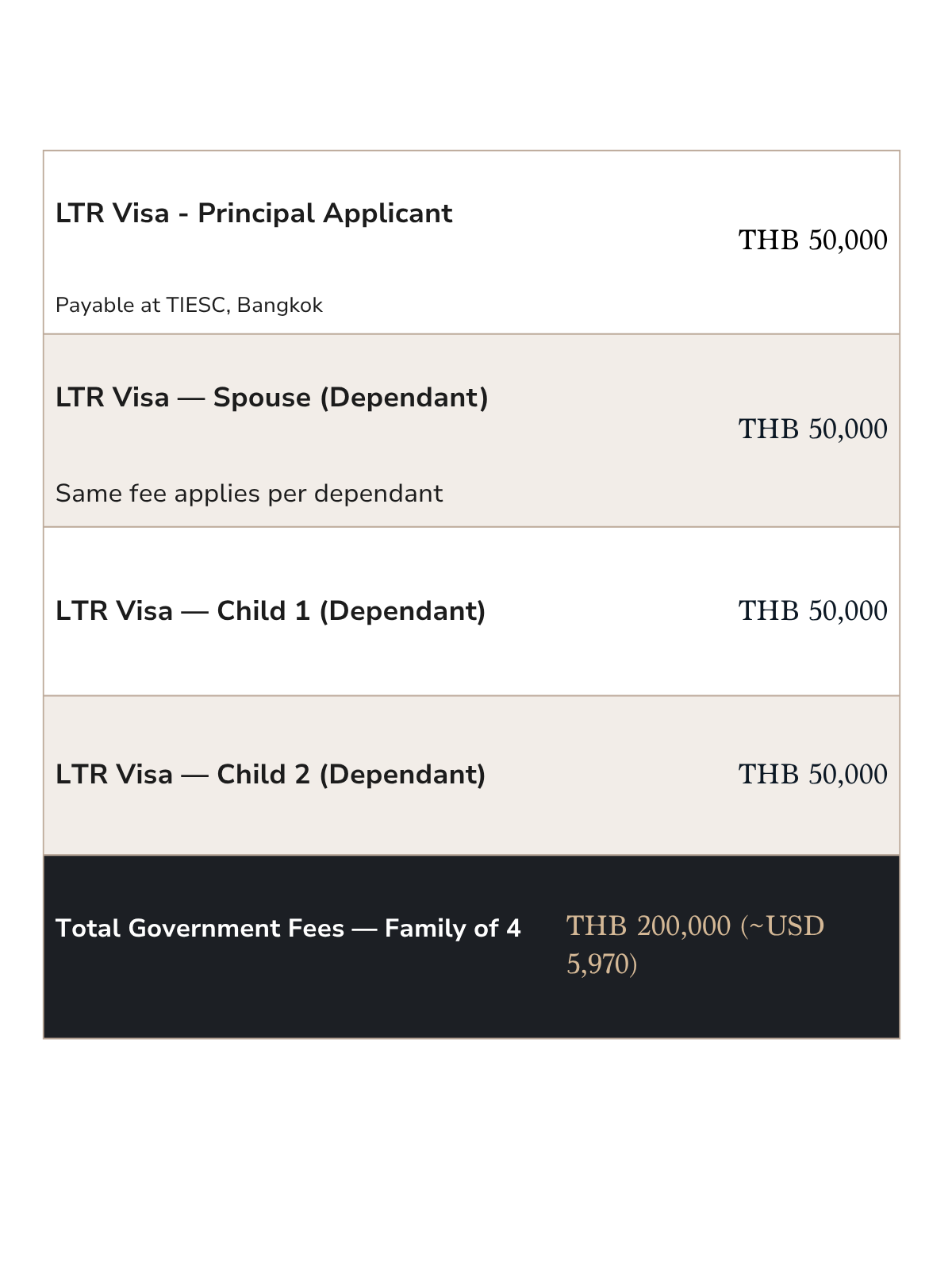
The government fee for the Thailand LTR Visa is THB 50,000 per person — applicable to both the principal applicant and each qualifying dependant. This fee is payable directly to Thai Immigration authorities at the time of visa issuance, and it covers the full 10-year visa term with multiple re-entries and the initial 5-year permission to stay.
There are two primary collection points for the LTR Visa stamp, and the fee treatment differs between them.
Collection at TIESC in Bangkok (Thailand Investment and Expat Services Centre): The fee is a fixed THB 50,000 per person, payable in Thai Baht at the time of the appointment. This is the most cost-effective and typically the most efficient route. TIESC — located at One Bangkok on Rama IV Road — consolidates the BOI and Immigration functions into a single venue, streamlining the stamp issuance process.
Collection at a Royal Thai Embassy or Consulate abroad: Fees are collected in the local currency at the Ministry of Foreign Affairs' consular exchange rate at the time of collection. In practice, this typically amounts to between USD 1,600 and USD 2,000 per person, depending on the jurisdiction. For a family of four collecting abroad, this can result in a meaningful additional cost compared to the TIESC route.
For most clients who have the flexibility to travel to Bangkok — or who are already planning to relocate — we recommend collecting at TIESC in Bangkok, both for cost efficiency and for the smoother overall process.
2. Health Insurance — The Most Significant Ongoing Cost
Every LTR Visa applicant — and every qualifying dependant — must hold a health insurance policy providing a minimum coverage of USD 50,000, inclusive of hospitalisation and medical treatment in Thailand, with at least 10 months of coverage remaining at the time of application. Standard travel insurance and life insurance without health riders are expressly excluded by the BOI.
Health insurance premiums vary considerably depending on the applicant's age, medical history, the insurer selected, the policy's deductible level, and the geographic scope of coverage. For a US family in the 50–60 age bracket, annual premiums for qualifying international health insurance typically range as follows:
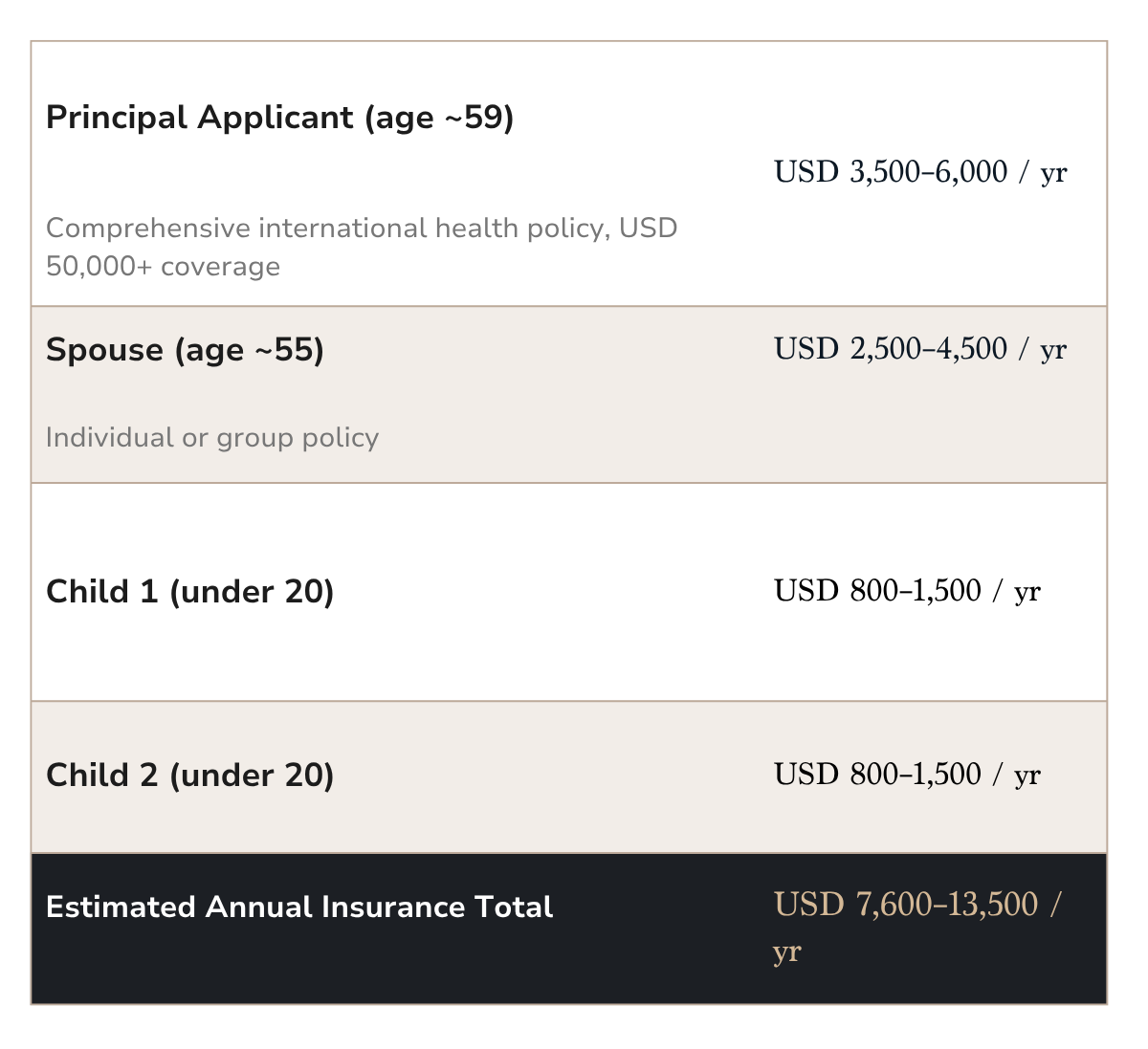
Insurers that are widely accepted for LTR Visa purposes include Pacific Cross, AXA, Cigna Global, Allianz Care, and BUPA International. A family group policy — where available — may reduce per-head premiums relative to individual policies. It is critical that any policy explicitly names Thailand as a covered territory for hospitalisation, not merely emergency treatment.
An important alternative exists for the health insurance requirement: applicants who maintain a bank deposit of at least USD 100,000 (for the principal applicant) or USD 25,000 (for each dependant) in a qualifying account for a minimum of 12 consecutive months prior to application may satisfy the health coverage requirement through this financial safety net route instead. This is worth knowing for applicants or dependants who face difficulty obtaining qualifying insurance due to pre-existing conditions.
3. Document Disbursements
LTR Visa applications for families applying from outside Thailand — particularly those with documents originating in multiple jurisdictions — involve a number of third-party disbursements. These are not optional extras; they are mandatory elements of a compliant application package.
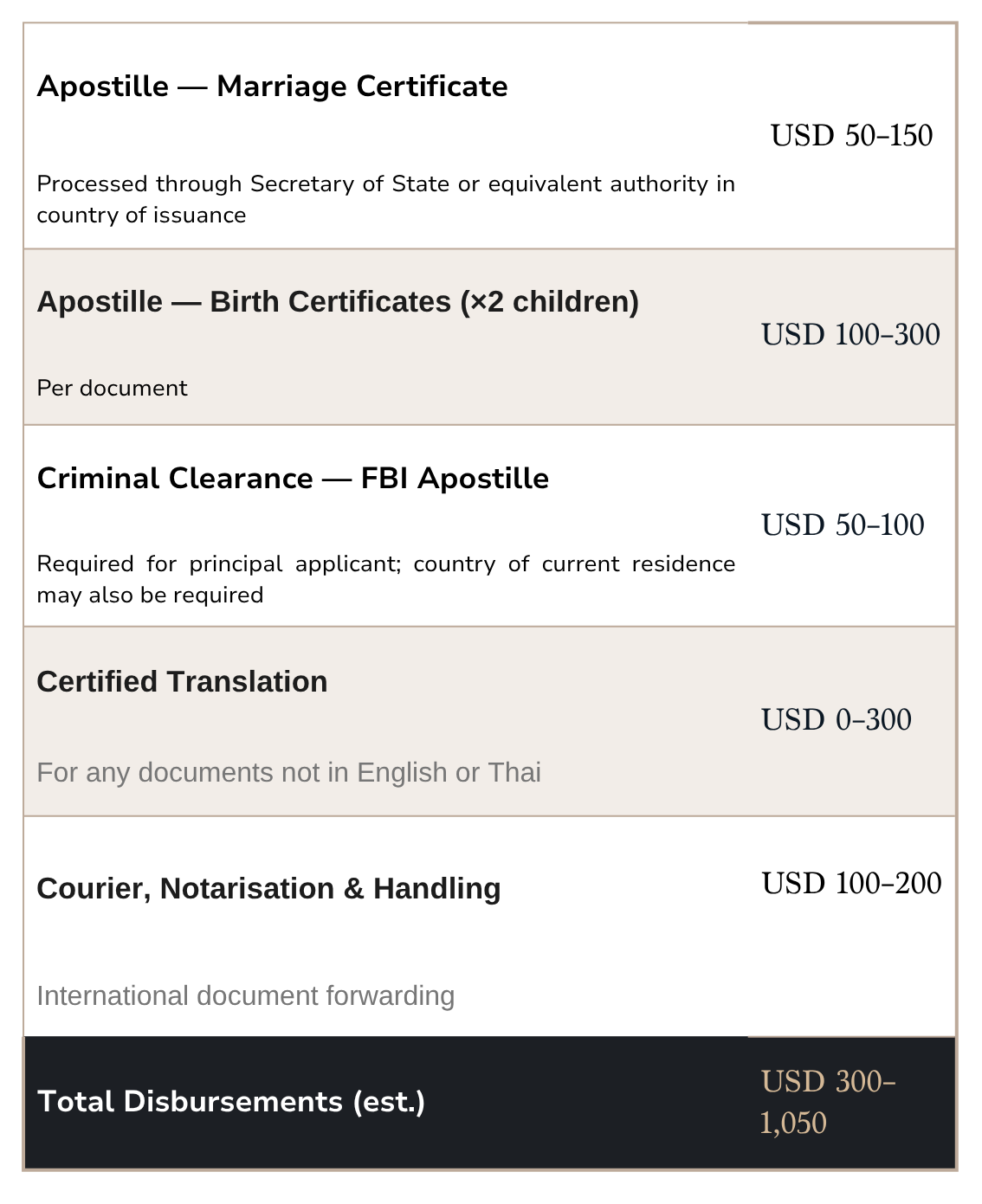
For US-origin documents, translation costs are typically minimal — most family documents are already in English. The FBI Apostille process for criminal clearance can take 4–8 weeks through standard channels, or 2–3 weeks via an authorised expediting agent. This timeline must be factored into your Phase 1 document preparation schedule.
4. Professional Legal Fees
Professional fees for LTR Visa case management vary significantly across the market — from automated agent platforms charging THB 15,000–35,000 for straightforward individual applications, to international law firms in Bangkok charging THB 150,000–200,000 for complex multi-applicant instructions with premium representation.
At Warus & James Raydar Inter Law, our fees reflect our position as a specialist cross-border legal practice with dual Thai and UK legal qualification — not an agent platform, and not a volume immigration firm. Our full-service case management for an LTR Wealthy Pensioner instruction covering a principal applicant and three dependants encompasses eligibility assessment and financial structuring, full BOI portal management, dependant application coordination and linking, Apostille and document management, embassy or TIESC appointment coordination, and direct handling of any Requests for Information from the BOI.
Our fees for this scope of instruction are presented clearly at the outset of every engagement, with a 70/30 payment structure: 70% payable upon engagement, and the remaining 30% upon official confirmation of the BOI Qualification Endorsement. There are no hidden fees and no surprise disbursements.
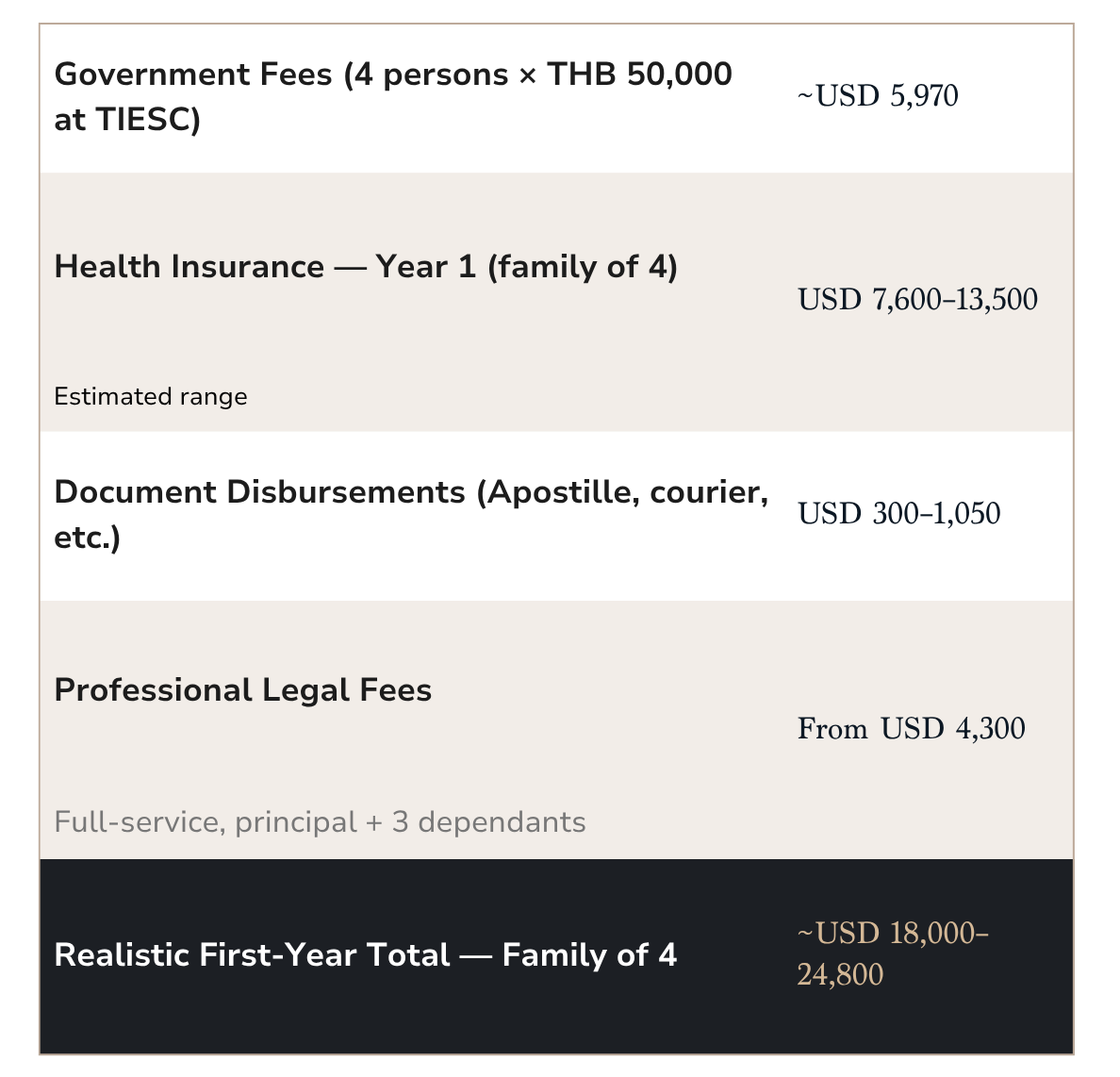
The All-In Estimate — A Family of Four, 2026
Is It Worth It? The Financial Case for the LTR Visa
The headline first-year cost for a family of four — between USD 18,000 and USD 25,000 all-in — is significant. But it needs to be contextualised against what the LTR Visa provides over its 10-year term and the financial advantages it unlocks.
For a Wealthy Pensioner living on USD 100,000 per year in passive income and remitting funds into Thailand, the foreign income tax exemption available exclusively to LTR holders is a structural advantage that grows in value year-on-year. Under Thailand's standard progressive tax rates, that income level could attract an annual Thai tax liability in excess of USD 20,000 — meaning the exemption pays for the entire cost of the LTR application within a single tax year.
Add to this the elimination of annual visa renewal costs, the reduction of 90-day reporting to an annual obligation, the inclusion of the entire family under one application, and the prestige and stability of a 10-year residency instrument — and the financial and quality-of-life case for the LTR Visa at this income level becomes compelling.
“For LTR holders remitting significant foreign income to Thailand, the tax exemption alone frequently exceeds the total first-year application cost. This is not a lifestyle premium — it is sound financial planning.”
Planning Your Budget: Our Recommendations
Based on our experience advising families through the LTR process, we recommend building your budget around the following principles. First, treat health insurance as your largest variable and obtain quotes early — the difference between a comprehensive and a minimal policy can be USD 3,000–5,000 per year for a couple, so it is worth spending time on insurer selection. Second, plan your Apostille timeline conservatively — allow 6–8 weeks from document collection to certified completion, particularly for FBI criminal clearance. Third, factor in the TIESC collection route if you can — the savings versus embassy collection for a family of four can be USD 1,000–2,000 or more depending on jurisdiction. Fourth, engage legal counsel before you begin document preparation — early structuring advice can identify issues with income documentation or asset classification before they become problems at submission stage.
Transparent Fee Structure
Request a Personalised Cost Assessment for Your Family
We provide a precise, written cost breakdown — including professional fees, government fees, and disbursement estimates — at the outset of every engagement. No surprises.
Email us at info@warusandjames.com
