

Relocating Your Whole Family to Thailand: A Complete Legal Guide to the LTR Visa for Families in 2026
— FAMILY RELOCATION · JUNE 2026
Moving to Thailand as an individual is one thing. Relocating with a spouse and children — across multiple document jurisdictions, with different legal requirements for each family member — is an entirely different legal undertaking. This guide explains exactly how the LTR Visa supports family relocation, and what you need to know before beginning the process.
BY WARUS AND JAMES RAYDAR INTER LAW Family Relocation
The decision to relocate a family internationally is rarely straightforward. Beyond the personal and logistical dimensions of a major move, there are legal requirements, document obligations, immigration timelines, and compliance conditions that must all be carefully managed — and managed correctly — if the relocation is to proceed smoothly and on schedule.
Thailand's Long-Term Resident (LTR) Visa is, in our view, the most compelling immigration pathway currently available for internationally mobile families who meet the financial thresholds. No other Thai long-stay visa provides a 10-year multi-entry permission, covering a spouse and up to four children, with annual instead of quarterly reporting, meaningful tax advantages, and airport fast-track privileges — all under a single principal application.
This article is written for families: those with a qualifying principal applicant who are planning to bring a spouse, children, or other eligible dependants to Thailand and want to understand the legal landscape thoroughly before engaging counsel and committing to a timeline.
Who Can Be Included as a Dependant on the LTR Visa?
The LTR Visa programme allows the principal applicant — the person who qualifies on the basis of income, assets, or professional credentials — to include qualifying dependants under their application. Dependants receive the same 10-year LTR Visa, the same annual reporting privilege, the same airport fast-track benefit, and in most categories, the same eligibility to apply for a Digital Work Permit independently.
Eligible dependants under the current LTR programme rules include:
A legally married spouse. Thailand's Marriage Equality Act came into force in January 2025, and the BOI has confirmed that same-sex spouses are fully eligible as LTR dependants provided the marriage is legally registered in the country of origin and supported by appropriate documentation.
Children of the principal applicant who are under 20 years of age at the time of application. This covers biological children, legally adopted children, and children for whom the applicant holds legal guardianship, subject to documentation. Adult children aged 20 or above are not eligible under the standard dependant category.
A maximum of four dependants per principal applicant may be included under the standard LTR programme rules currently in force. Expanded dependent eligibility — including parents of the principal applicant — was announced in the BOI's February 2025 update, but implementing regulations from the Ministry of Interior and Immigration Bureau had not been issued as of the date of this article. Families expecting to include parents should seek updated legal advice at the time of their application.
“The LTR Visa is the only Thai long-stay instrument that allows a principal applicant to bring an entire family — spouse and children — under one 10-year application, with no separate income requirements for dependants”
Do Dependants Need Their Own Financial Qualifications?
This is one of the most frequently asked questions from family clients, and the answer is reassuring: dependants do not need to independently satisfy the LTR income or asset thresholds. The qualification rests entirely with the principal applicant. If the principal qualifies — whether on the USD 80,000 passive income route or the USD 40,000 income plus USD 250,000 Thai investment route — the dependants qualify with them.
There is, however, one financial requirement that applies individually to each dependant: health insurance. Every family member included in the LTR application — including each child — must hold a qualifying health insurance policy providing minimum coverage of USD 50,000, inclusive of hospitalisation and medical treatment in Thailand, with at least 10 months of coverage remaining at the date of application.
For families with children who have pre-existing health conditions that complicate insurance applications, an alternative route exists: maintaining a bank deposit of at least USD 25,000 per dependant (USD 100,000 for the principal applicant) for a minimum of 12 consecutive months prior to application. This financial safety net route satisfies the health coverage requirement without requiring an active insurance policy.
The Document Challenge — Why Family Applications Are More Complex
A single-applicant LTR Visa is a manageable process for an organised individual with straightforward income documentation. A family of four, however, introduces multiple layers of complexity that are frequently underestimated by those who begin the process without specialist legal guidance.
Multi-Jurisdictional Documents
Dependant applications require documents that, by their nature, originate in countries other than Thailand. A marriage certificate issued in the United States, children's birth certificates issued in different US states, a criminal clearance from the FBI, and supporting identity documents for each family member — all of these must be authenticated for use in Thailand through the Apostille process.
Under the Hague Apostille Convention (to which both the US and Thailand are signatories), documents issued in the United States can be authenticated by the relevant Secretary of State's office for the state in which the document was issued, or through the US Department of State for federal documents such as FBI criminal clearance. Each Apostille must be obtained separately, and processing times vary by state and document type — typically 2–6 weeks for state-level documents and 4–8 weeks for FBI clearance through standard channels.
Documents not originally in English — including any documents from a country of prior residence — must be accompanied by a certified professional translation into English or Thai before submission to the BOI. For families with recent residence in non-English-speaking countries, this is an additional preparation step that must be factored into the Phase 1 timeline.
Separate BOI Portal Accounts for Each Applicant
A detail that catches many families by surprise: each LTR applicant — including each dependant — must have their own account on the BOI's LTR Visa application portal. Documents for each family member must be uploaded to their individual account, and the dependant accounts must then be correctly linked to the principal applicant's file before submission.
Managing four separate portal accounts simultaneously — with individual document sets, individual status tracking, and coordinated submission — requires a structured approach. Errors in linking dependant accounts are a common source of delay in family applications and, in some cases, lead to Requests for Information (RFI) from the BOI that extend the processing timeline.
Coordinated Insurance Documentation
Each family member's health insurance policy must be individually verified and uploaded as part of their separate application. Where different family members hold different policies — or where a single group policy covers multiple family members — the documentation must be structured to clearly evidence the USD 50,000 minimum coverage for each individual. Group policy documents that do not individually specify per-person coverage amounts are a recurring issue in family applications and must be confirmed in writing with the insurer before submission.
The Application Timeline for Families — What to Expect
A well-managed family LTR application follows a structured phased timeline. Based on our experience with family instructions, the typical end-to-end process from initial engagement to visa stamp collection takes approximately 4–6 months when document preparation begins promptly and no significant issues arise.
Recommended Phased Timeline — Family of 4
Phase 1 (Months 1–3): Eligibility assessment, income and asset structuring, document collection, Apostille processing for all family members, health insurance procurement and policy verification, BOI portal account creation for all applicants.
Phase 2 (Month 3–4): Submission of completed application to BOI for Qualification Endorsement. BOI standard processing is approximately 20 working days, though complex family applications or those requiring clarification may extend to 30–45 working days.
Phase 3 (Month 4–5): Receipt of Qualification Endorsement. The endorsed applicants must collect the physical visa stamp within 60 days of endorsement. Appointment is booked at TIESC in Bangkok or a designated Royal Thai Embassy.
Phase 4 (Month 5–6): Physical visa stamp collection for all family members at a single coordinated appointment. All dependants must collect at the same location as the principal applicant.
What Rights Do Dependants Receive?
LTR Dependant Visa holders enjoy a substantial package of rights and benefits — far exceeding what is available under any other Thai dependant visa category. They receive a 10-year multiple-entry visa with the same initial 5-year stay permission as the principal applicant. They benefit from the same annual reporting obligation (rather than 90-day reporting) and the same airport fast-track privilege at designated international airports in Thailand.
Critically, dependant spouses and children of LTR holders in the Wealthy Global Citizen, Wealthy Pensioner, and Work-from-Thailand Professional categories are eligible to apply for a Digital Work Permit independently. This means a spouse who holds their own professional skills or who wishes to work remotely while in Thailand can do so legally under a Digital Work Permit linked to their LTR Dependant status — without being subject to the standard 4:1 Thai-to-foreigner employment ratio.
Common Mistakes Families Make — And How to Avoid Them
Starting document preparation too late. The Apostille process for FBI criminal clearance typically takes 4–8 weeks through standard channels. Families who begin this process at the same time as the BOI application often face timeline pressure that could have been avoided. We advise beginning document preparation at least 12–16 weeks before the intended submission date.
Assuming one insurer or policy covers the whole family adequately. Many international health insurance policies provide group coverage with aggregate limits rather than per-person minimums. The BOI requires evidence of USD 50,000 coverage per individual — and a group policy that does not individually specify per-person coverage may not satisfy this requirement without a supplementary letter from the insurer. Always confirm per-person coverage amounts in writing before submission.
Relying on an agent platform for a complex family instruction. Automated visa platforms are built for individual, straightforward applications. A family instruction with multi-jurisdictional documents, multiple dependant portal accounts, coordinated insurance verification, and a fixed relocation deadline requires the kind of responsive, expert case management that only a qualified legal practitioner can provide. The cost difference between an agent platform and specialist legal counsel is modest relative to the risk of errors, delays, or — in the worst case — a rejection that sets the family's relocation timeline back by months.
Not accounting for the 60-day endorsement collection window. Once the BOI issues the Qualification Endorsement, all applicants — principal and dependants — must collect their physical visa stamps within 60 days. Families who have not arranged their travel to Bangkok or their embassy appointment in advance can find themselves under significant time pressure. Planning the collection appointment before the endorsement is received is strongly advisable.
Why Specialist Legal Counsel Matters for Family Instructions
At Warus & James Raydar Inter Law, we are a specialist cross-border legal practice with dual Thai and UK legal qualification. Our principal, James Raydar, holds a Thai Lawyer Licence and is a UK Registered Foreign Lawyer continuously registered with the Solicitors Regulation Authority — a combination that is genuinely rare in the immigration advisory market and that gives us a unique perspective on multi-jurisdictional family instructions.
We manage every family instruction as a single integrated legal matter. That means one named lawyer who knows every member of your file — not a fragmented case across multiple team members or a portal submission without human oversight. It means proactive document timeline management, not reactive problem-solving when something goes wrong. And it means direct liaison with the BOI, handling any Requests for Information with the precision and authority that your family's relocation deserves.
Your family's move to Thailand is not an administrative exercise. It is one of the most significant decisions you will make — and it deserves to be managed accordingly.
Family Relocation Specialists
Ready to Begin Your Family's Thailand Relocation?
We manage the entire process — from eligibility assessment and document preparation through to visa stamp collection — as a single integrated family instruction. Speak to a named, qualified lawyer from day one.
Email us at info@warusandjames.com · warusandjames.com

Thailand LTR Visa: The Complete Cost Breakdown for 2026 — What You Will Actually Pay
— COSTS & FEES · JUNE 2026
Most published guides quote a single government fee and leave the rest to your imagination. This article provides a complete, honest, itemised breakdown of every cost involved in a Thailand LTR Visa application — for both individual applicants and families.
BY WARUS & JAMES RAYDAR INTER LAW Fees & Costs
One of the most common questions we receive from prospective clients considering the Thailand Long-Term Resident (LTR) Visa is a simple one: how much does it actually cost? The answer, with full transparency, is more layered than a single number — and understanding each component helps you plan properly, avoid surprises, and assess whether the investment makes financial sense for your situation.
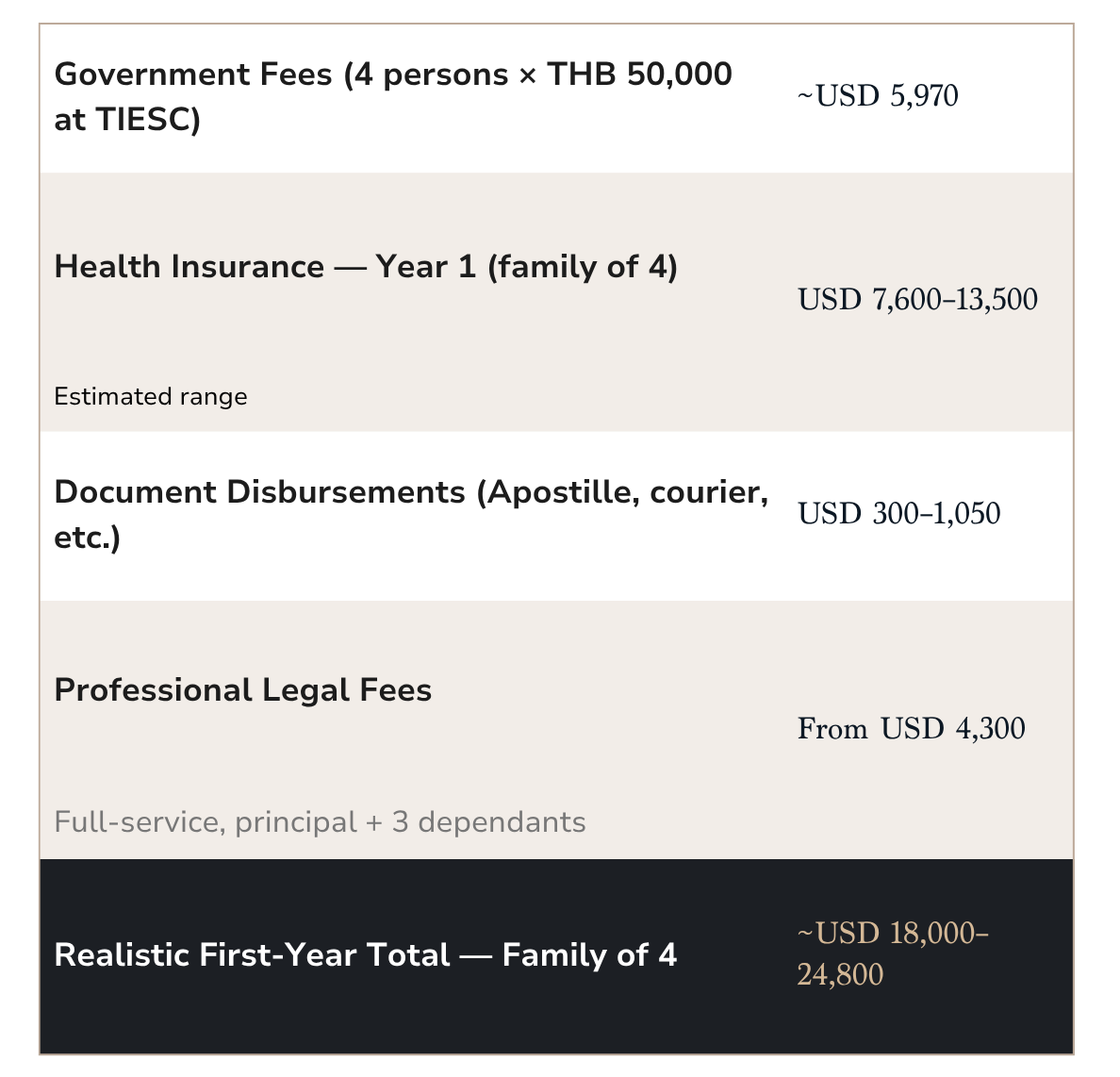
This guide breaks down every cost category in the LTR Visa process: the mandatory government fees, the health insurance obligation, the disbursements and document preparation costs, and the professional legal fees for full-service case management. We also provide a realistic all-in estimate for a family of four — one of the most common client profiles we advise on.
One critical distinction to understand from the outset: government fees are fixed and non-negotiable, set by the Thai Board of Investment and Immigration Bureau. Professional fees and insurance premiums, by contrast, vary significantly depending on the provider, the complexity of the case, and the age and health profile of the applicants.
1. Government Visa Fees
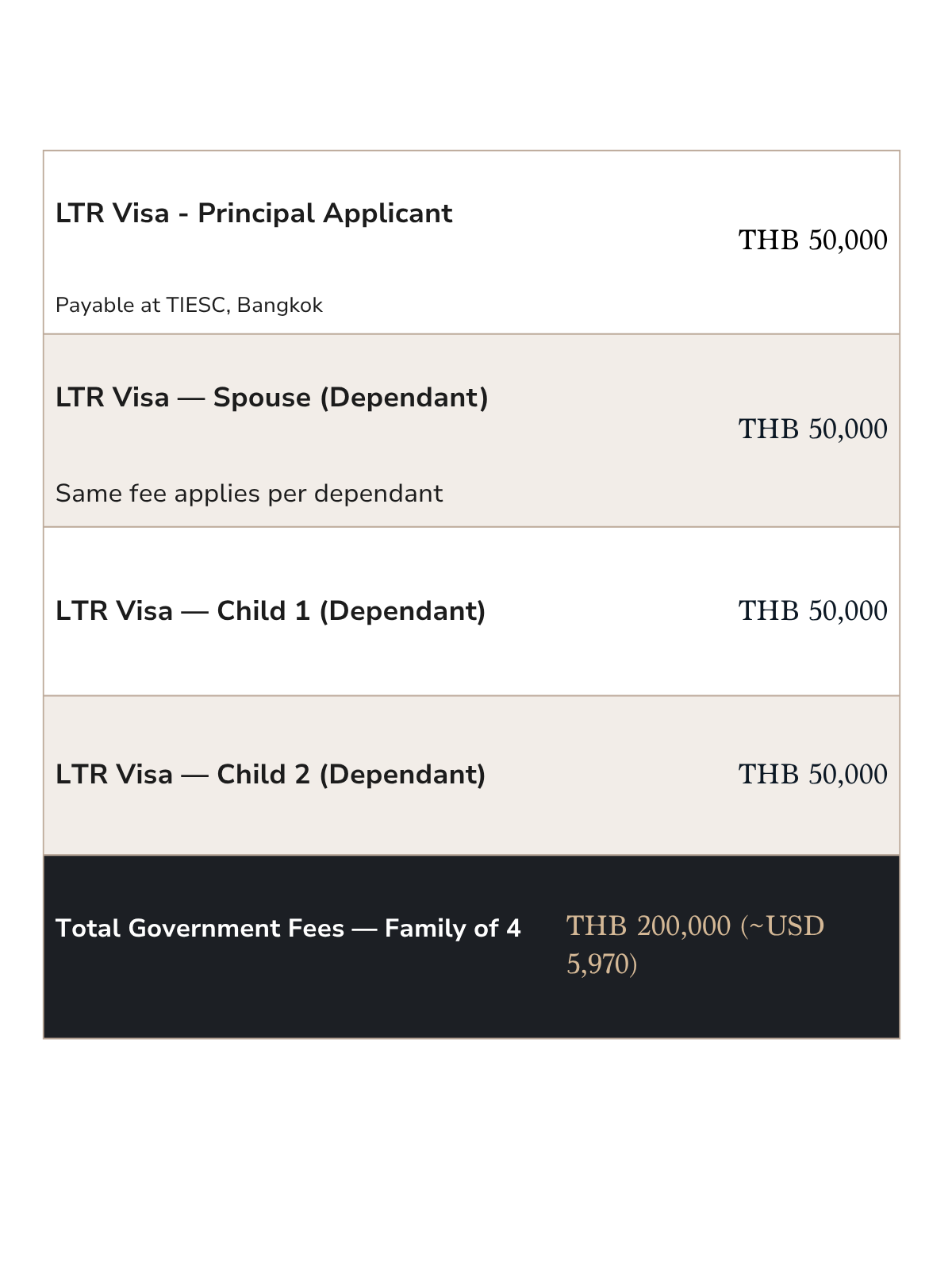
The government fee for the Thailand LTR Visa is THB 50,000 per person — applicable to both the principal applicant and each qualifying dependant. This fee is payable directly to Thai Immigration authorities at the time of visa issuance, and it covers the full 10-year visa term with multiple re-entries and the initial 5-year permission to stay.
There are two primary collection points for the LTR Visa stamp, and the fee treatment differs between them.
Collection at TIESC in Bangkok (Thailand Investment and Expat Services Centre): The fee is a fixed THB 50,000 per person, payable in Thai Baht at the time of the appointment. This is the most cost-effective and typically the most efficient route. TIESC — located at One Bangkok on Rama IV Road — consolidates the BOI and Immigration functions into a single venue, streamlining the stamp issuance process.
Collection at a Royal Thai Embassy or Consulate abroad: Fees are collected in the local currency at the Ministry of Foreign Affairs' consular exchange rate at the time of collection. In practice, this typically amounts to between USD 1,600 and USD 2,000 per person, depending on the jurisdiction. For a family of four collecting abroad, this can result in a meaningful additional cost compared to the TIESC route.
For most clients who have the flexibility to travel to Bangkok — or who are already planning to relocate — we recommend collecting at TIESC in Bangkok, both for cost efficiency and for the smoother overall process.
2. Health Insurance — The Most Significant Ongoing Cost
Every LTR Visa applicant — and every qualifying dependant — must hold a health insurance policy providing a minimum coverage of USD 50,000, inclusive of hospitalisation and medical treatment in Thailand, with at least 10 months of coverage remaining at the time of application. Standard travel insurance and life insurance without health riders are expressly excluded by the BOI.
Health insurance premiums vary considerably depending on the applicant's age, medical history, the insurer selected, the policy's deductible level, and the geographic scope of coverage. For a US family in the 50–60 age bracket, annual premiums for qualifying international health insurance typically range as follows:
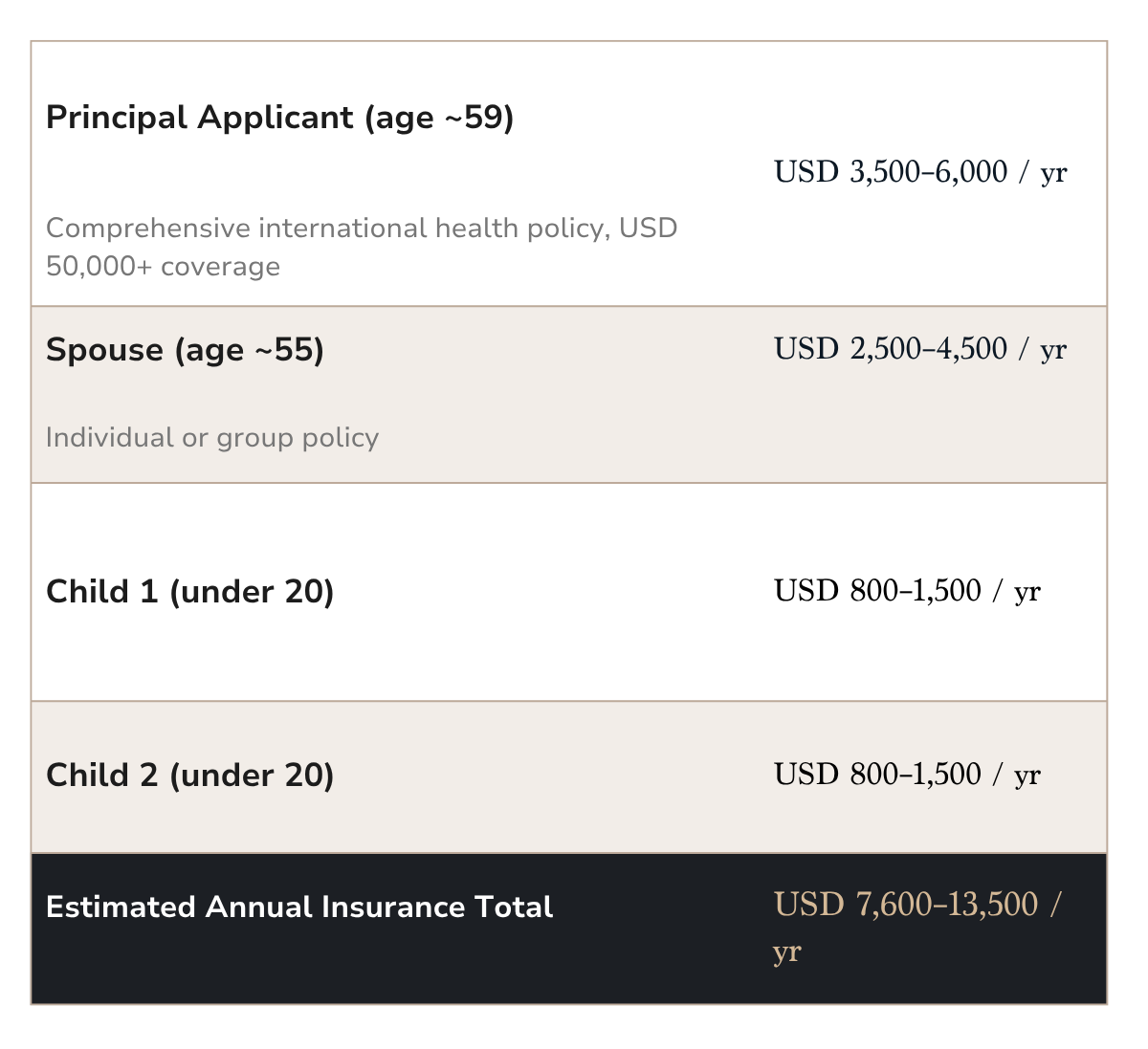
Insurers that are widely accepted for LTR Visa purposes include Pacific Cross, AXA, Cigna Global, Allianz Care, and BUPA International. A family group policy — where available — may reduce per-head premiums relative to individual policies. It is critical that any policy explicitly names Thailand as a covered territory for hospitalisation, not merely emergency treatment.
An important alternative exists for the health insurance requirement: applicants who maintain a bank deposit of at least USD 100,000 (for the principal applicant) or USD 25,000 (for each dependant) in a qualifying account for a minimum of 12 consecutive months prior to application may satisfy the health coverage requirement through this financial safety net route instead. This is worth knowing for applicants or dependants who face difficulty obtaining qualifying insurance due to pre-existing conditions.
3. Document Disbursements
LTR Visa applications for families applying from outside Thailand — particularly those with documents originating in multiple jurisdictions — involve a number of third-party disbursements. These are not optional extras; they are mandatory elements of a compliant application package.
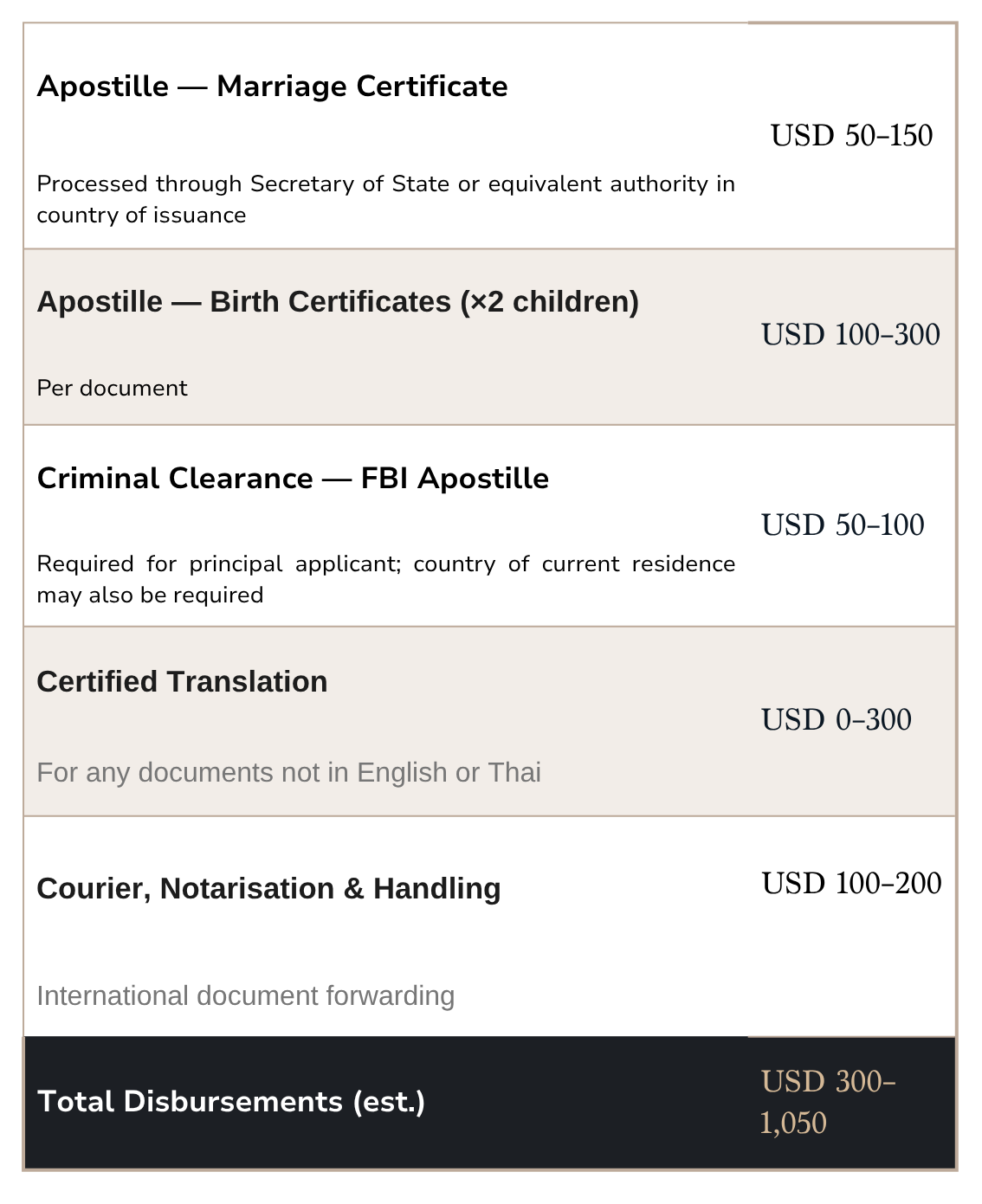
For US-origin documents, translation costs are typically minimal — most family documents are already in English. The FBI Apostille process for criminal clearance can take 4–8 weeks through standard channels, or 2–3 weeks via an authorised expediting agent. This timeline must be factored into your Phase 1 document preparation schedule.
4. Professional Legal Fees
Professional fees for LTR Visa case management vary significantly across the market — from automated agent platforms charging THB 15,000–35,000 for straightforward individual applications, to international law firms in Bangkok charging THB 150,000–200,000 for complex multi-applicant instructions with premium representation.
At Warus & James Raydar Inter Law, our fees reflect our position as a specialist cross-border legal practice with dual Thai and UK legal qualification — not an agent platform, and not a volume immigration firm. Our full-service case management for an LTR Wealthy Pensioner instruction covering a principal applicant and three dependants encompasses eligibility assessment and financial structuring, full BOI portal management, dependant application coordination and linking, Apostille and document management, embassy or TIESC appointment coordination, and direct handling of any Requests for Information from the BOI.
Our fees for this scope of instruction are presented clearly at the outset of every engagement, with a 70/30 payment structure: 70% payable upon engagement, and the remaining 30% upon official confirmation of the BOI Qualification Endorsement. There are no hidden fees and no surprise disbursements.
The All-In Estimate — A Family of Four, 2026
Is It Worth It? The Financial Case for the LTR Visa
The headline first-year cost for a family of four — between USD 18,000 and USD 25,000 all-in — is significant. But it needs to be contextualised against what the LTR Visa provides over its 10-year term and the financial advantages it unlocks.
For a Wealthy Pensioner living on USD 100,000 per year in passive income and remitting funds into Thailand, the foreign income tax exemption available exclusively to LTR holders is a structural advantage that grows in value year-on-year. Under Thailand's standard progressive tax rates, that income level could attract an annual Thai tax liability in excess of USD 20,000 — meaning the exemption pays for the entire cost of the LTR application within a single tax year.
Add to this the elimination of annual visa renewal costs, the reduction of 90-day reporting to an annual obligation, the inclusion of the entire family under one application, and the prestige and stability of a 10-year residency instrument — and the financial and quality-of-life case for the LTR Visa at this income level becomes compelling.
“For LTR holders remitting significant foreign income to Thailand, the tax exemption alone frequently exceeds the total first-year application cost. This is not a lifestyle premium — it is sound financial planning.”
Planning Your Budget: Our Recommendations
Based on our experience advising families through the LTR process, we recommend building your budget around the following principles. First, treat health insurance as your largest variable and obtain quotes early — the difference between a comprehensive and a minimal policy can be USD 3,000–5,000 per year for a couple, so it is worth spending time on insurer selection. Second, plan your Apostille timeline conservatively — allow 6–8 weeks from document collection to certified completion, particularly for FBI criminal clearance. Third, factor in the TIESC collection route if you can — the savings versus embassy collection for a family of four can be USD 1,000–2,000 or more depending on jurisdiction. Fourth, engage legal counsel before you begin document preparation — early structuring advice can identify issues with income documentation or asset classification before they become problems at submission stage.
Transparent Fee Structure
Request a Personalised Cost Assessment for Your Family
We provide a precise, written cost breakdown — including professional fees, government fees, and disbursement estimates — at the outset of every engagement. No surprises.
Email us at info@warusandjames.com

Thailand LTR Visa vs. Retirement Visa: Which Is the Right Choice for You in 2026?
— THAILAND IMMIGRATION · JUNE 2026
For anyone planning long-term residency in Thailand, choosing between the Non-Immigrant O Retirement Visa and the Long-Term Resident (LTR) Visa is one of the most consequential immigration decisions you will make — and the right answer depends entirely on your financial profile, family situation, and long-term goals.
BY WARUS & JAMES RAYDAR INTER LAW ·THAILAND IMMIGRATION
Thailand has long been one of the world's most popular destinations for long-term expatriates, retirees, and internationally mobile families. Its combination of high quality of life, affordable cost of living, excellent private healthcare, and warm climate makes it an enduringly attractive relocation destination — particularly for citizens from the United States, the United Kingdom, Europe, and Australia.
In recent years, Thailand's immigration framework has evolved significantly. The introduction of the Long-Term Resident (LTR) Visa in September 2022 — administered by Thailand's Board of Investment (BOI) — created a fundamentally new option for high-net-worth individuals and qualifying retirees seeking genuine long-term stability in the country. For many, the question is no longer simply "how do I retire in Thailand?" but rather "which pathway best serves my family and financial interests over the next decade?"
This guide sets out a comprehensive, legally informed comparison of both routes — examining eligibility, duration, financial requirements, family provisions, tax implications, and practical administrative burdens — so that you can make an informed decision before engaging legal counsel.
Understanding the Two Pathways
The Non-Immigrant O-A / O-X Retirement Visa
The Non-Immigrant O-A(Retirement) Visa has existed in various forms for decades and remains the most widely used long-stay option for retirees in Thailand. It is issued initially for 90 days or one year, and can be renewed annually at a local Immigration office in Thailand, provided the applicant continues to meet the financial requirements.
To qualify for the standard Non-O-A Retirement Visa, applicants must be aged 50 or above and satisfy one of the following financial criteria: savings of at least THB 800,000; monthly income or pension of at least THB 65,000; or a combination of savings and income totaling at least THB 800,000. Upon annual extension, applicants must continue to satisfy one of these financial requirements, including maintaining at least THB 800,000 held in a Thai bank account, monthly income or pension of at least THB 65,000, or a combination totaling at least THB 800,000 per year. There is no investment requirement, no BOI involvement, and the process can be managed through a local Thai Immigration office or a Royal Thai Embassy or Consulate abroad.
The appeal of the Retirement Visa lies in its relative accessibility and the simplicity of its initial setup. However, it comes with a number of ongoing administrative obligations that many retirees find burdensome over time — most notably the requirement to report to Thai Immigration every 90 days and to renew the visa annually with fresh financial evidence.
The LTR Visa (Wealthy Pensioner Category)
The Long-Term Resident Visa is a fundamentally different product — a premium, BOI-administered residency programme designed to attract high-value individuals to Thailand over a 10-year horizon. The Wealthy Pensioner category within the LTR programme is specifically designed for retirees aged 50 and above who hold qualifying passive income or a combination of passive income and Thai-based assets.
To qualify under the Wealthy Pensioner stream, applicants must meet one of two financial thresholds: a passive income — from pensions, annuities, dividends, interest, or rental income — of at least USD 80,000 per annum; or a passive income of between USD 40,000 and USD 79,999 per annum combined with a qualifying investment in Thailand of not less than USD 250,000 which may include government bonds, foreign direct investment, or registered Thai property.
In addition to the income or asset threshold, all LTR applicants must hold qualifying health insurance coverage of at least USD 50,000 per person, inclusive of treatment in Thailand, with at least 10 months of coverage remaining at the time of application.
“The LTR Visa is not simply a longer version of the Retirement Visa. It is a structurally different residency instrument — one that trades a higher entry threshold for a decade of stability, reduced administrative burden, and meaningful tax advantages.”
Side-by-Side Comparison
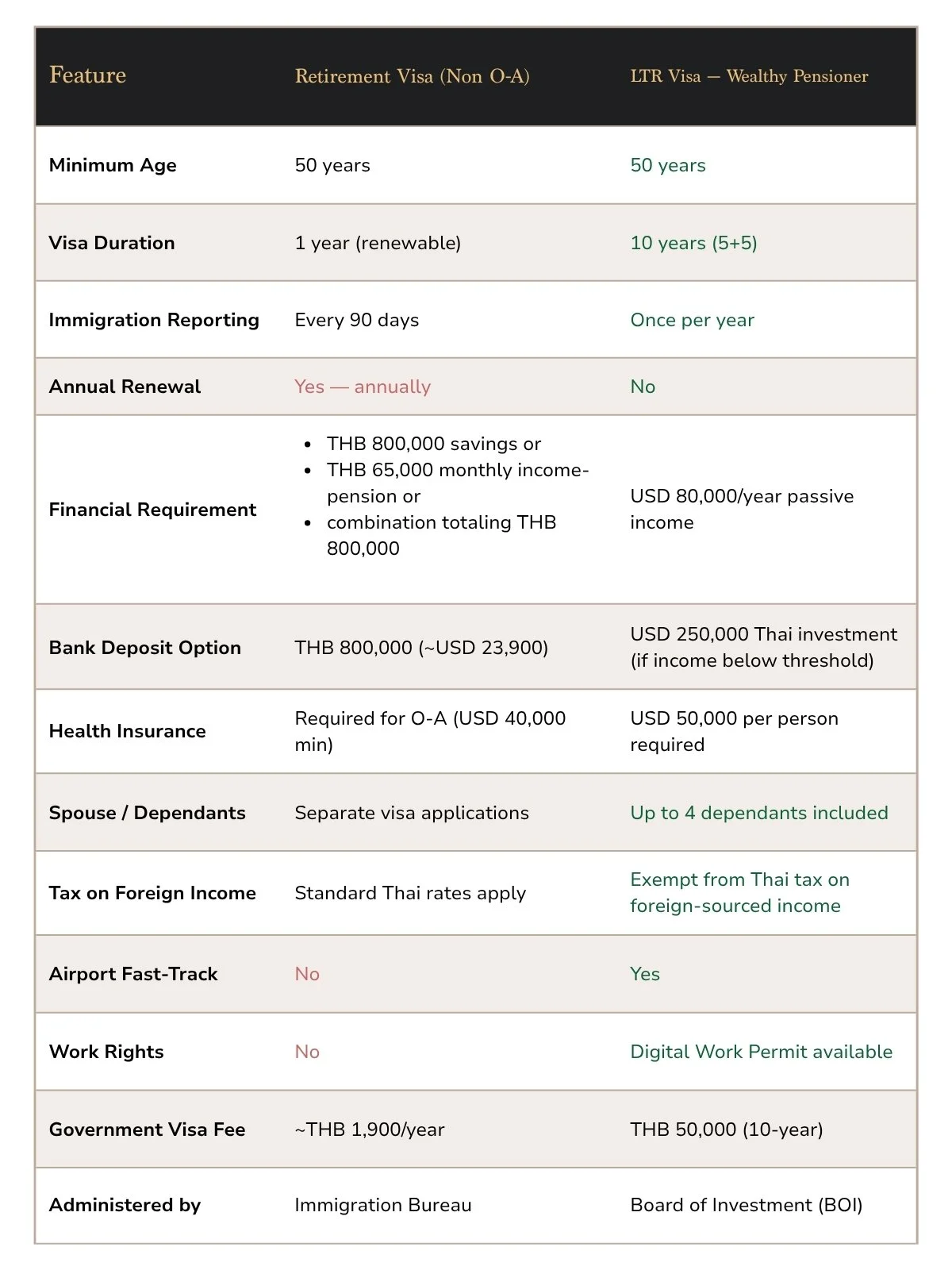
The Tax Advantage — A Factor That Changes the Calculation
One dimension that is frequently underappreciated in visa comparisons is the tax treatment of foreign-sourced income. Thailand updated its tax rules in 2024, making foreign income remitted into Thailand in the same tax year it is earned potentially assessable for Thai income tax — regardless of visa type.
However, LTR Visa holders in the Wealthy Pensioner category enjoy a specific statutory exemption from Thai personal income tax on their foreign-sourced income. This is not a grey area or a planning position — it is an explicit benefit of the LTR programme, established by Royal Decree and confirmed in the BOI's programme documentation.
For a retiree living on USD 80,000–150,000 per year in passive income and remitting funds to Thailand regularly, this exemption can represent a tax saving of tens of thousands of dollars annually. For high-income retirees, the financial benefit of the LTR Visa's tax exemption alone can exceed the entire cost of the application — including legal fees, government fees, and health insurance — within the first year of residency.
Retirement Visa holders enjoy no equivalent protection. If they spend more than 180 days per calendar year in Thailand — which the vast majority of long-term residents will — they become Thai tax residents and are subject to Thai progressive income tax rates on assessable foreign income remitted into Thailand.
Administrative Burden — The Hidden Cost of the Retirement Visa
The 90-day reporting obligation under the Retirement Visa is more significant than it might first appear. Every 90 days, the visa holder must either present in person at a Thai Immigration office, submit a postal notification, or — where available — file online. Failure to report on time results in a fine of THB 2,000 per occurrence. Over a 10-year period, this amounts to 40 mandatory interactions with the immigration system.
Similarly, annual visa renewal requires fresh bank statements, income evidence, and completion of TM.7 and TM.30 forms, often with in-person attendance. For internationally mobile retirees — those who travel frequently between countries — managing the renewal window and maintaining continuous compliance can become a genuine logistical challenge.
The LTR Visa replaces annual extension applications with a long-term residence framework, granting an initial five-year stay that may be renewed for a further five years, subject to continued qualification. Combined with a single annual address report, this significantly reduces the administrative burden associated with traditional retirement-based immigration categories. For retirees seeking long-term stability, convenience, and predictability in Thailand, the LTR Visa offers a compelling alternative.
Which Pathway Is Right for You?
Choose the LTR Visa if
Your passive income exceeds USD 80,000 per year — or you hold USD 250,000 or more in qualifying Thai assets alongside USD 40,000+ annual income.
You are relocating with a spouse and/or children and want the entire family covered under a single application umbrella.
You intend to remit significant foreign income into Thailand and want legal certainty over your tax position.
You value long-term stability and want to avoid the annual renewal cycle of the standard Retirement Visa.
You are planning a permanent or near-permanent relocation and want a 10-year framework to build your life around.
The Retirement Visa may suit you better if
Your passive income falls below the USD 40,000 LTR threshold and you do not hold significant Thai assets.
You are relocating alone and do not have dependant family members to include.
You prefer a lower initial financial commitment and are comfortable with annual renewal.
You are in a transitional phase and intend to build toward LTR eligibility over the coming years.
A Note on Legal Advice
The comparison above provides a general framework, but the right decision for your circumstances depends on a precise assessment of your income structure, the nature and jurisdiction of your assets, your family composition, your tax residency position in your home country, and your intended pattern of residence in Thailand. Income from employment, director's fees, or active business activities does not count toward the LTR passive income threshold — a distinction that catches many applicants by surprise.
At Warus & James Raydar Inter Law, we conduct a thorough eligibility assessment before any application is initiated, ensuring that the pathway you choose is the one you can qualify for — and the one that genuinely serves your long-term interests in Thailand and internationally.
Get Expert Guidance
Not Sure Which Visa Is Right for Your Situation?
Our initial consultation covers your full eligibility profile, income structuring, family situation, and recommended pathway — before you commit to anything.
Or email us directly at info@warusandjames.com

What we do at Warus & James Raydar Interlaw
It All Begins Here
Cross-border Thai-UK legal practice. Based in London.
We advise in two directions — Thai nationals navigating UK law, and British nationals, expats, and international clients navigating Thai law.
FOR THAI NATIONALS AND INVESTORS — UK
UK Property — Conveyancing, title due diligence, SDLT advice, and structuring for non-resident buyers.
UK Company Formation — Limited companies, shareholder agreements, commercial contracts, and joint ventures for Thai businesses expanding into the UK.
UK Immigration — Skilled Worker, Global Talent, Innovator Founder, and family visas. Sponsor licence and right to work compliance.
Cross-Border Advice — Thai-UK transactions, international contracts, and legal support for families and businesses with interests in both countries.
FOR BRITISH NATIONALS, EXPATS & INTERNATIONAL CLIENTS — THAILAND
Buying Property in Thailand — Title verification, condominium foreign quota, leasehold structuring, and remittance compliance.
Thai Wills & Estate Planning — Thai wills for expats, coordinated with UK wills. Advice on Thai intestacy law.
Thailand Visa & Residency — LTR visa (Wealthy Pensioner, Wealthy Global Citizen, Work-from-Thailand). Retirement visa. Financial and insurance guidance.
Thai Family & Marriage Law — Prenuptial agreements, divorce, foreign spouse property rights, child custody, cross-border family matters.
Company Formation in Thailand — Incorporation, FBA compliance, BOI promotion, joint ventures, employment contracts, and commercial leases.
Thai Probate — Advising UK-based heirs on Thai probate. Recovering Thai assets — condominiums, bank accounts, business shares — for families abroad.
“One firm. Two jurisdictions.
Advice in English and Thai — from London.”
If your matter touches Thailand, the UK, or both — we would be glad to help.